
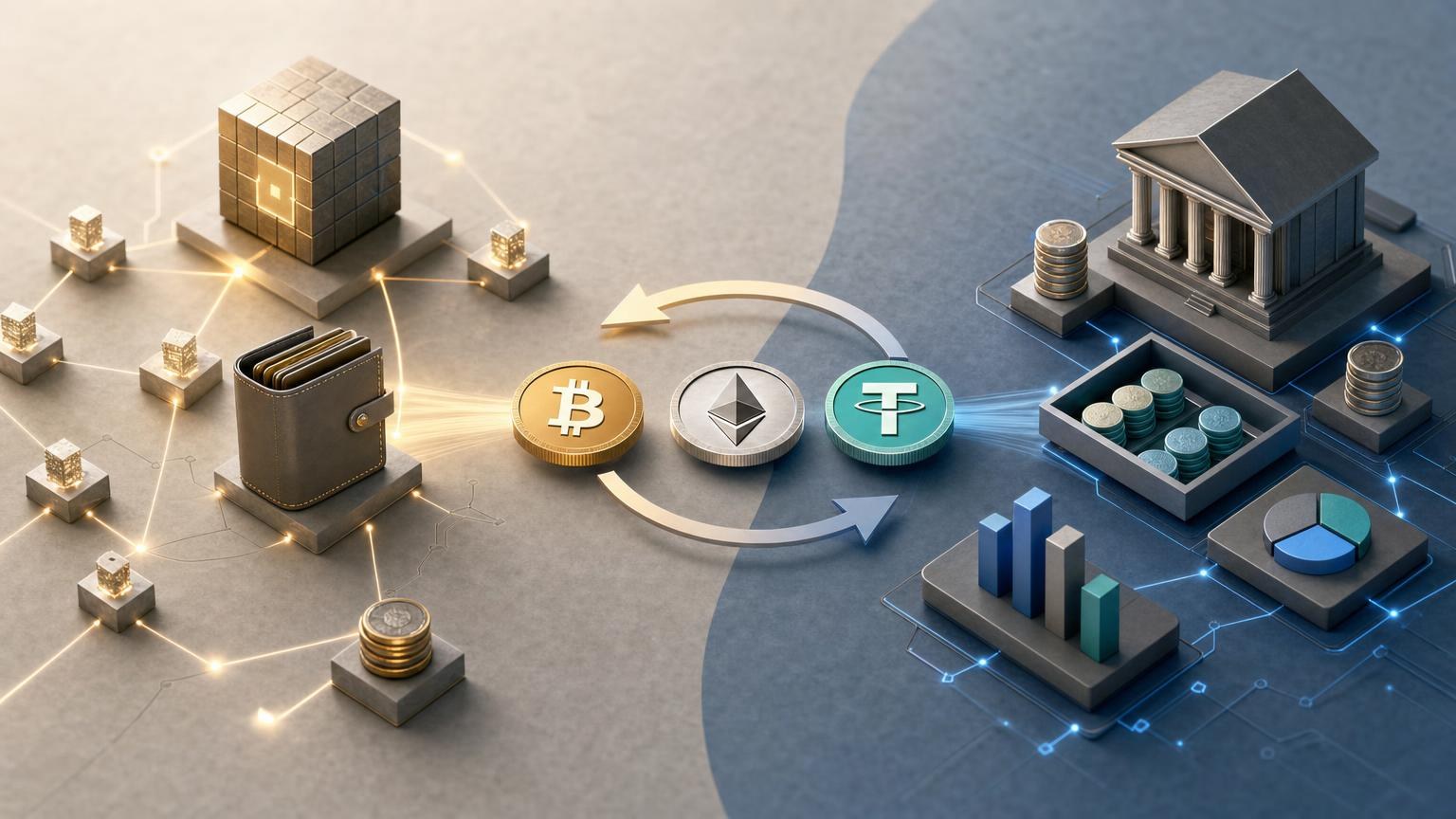
The cost of exchanging BTC, ETH or USDT usually has at least two independent components: the blockchain network fee and the exchange service’s charge. The first pays for recording or executing a transaction on a blockchain. The second covers the exchange operation and may appear as a separate fee, as part of the quoted rate, or through a combination of both. Comparing only one component can therefore produce a misleading result.
Compact knowledge map: fee structure → blockchain mechanism → asset-specific behavior → quote comparison → network and address checks → final verification. The central distinction is simple: network conditions determine the blockchain cost, while the service determines its own pricing method and displayed quote. USDT adds another variable because the token exists on multiple blockchains, so its network cannot be inferred from the ticker alone.
Route 1 — understand quickly: read “The two fee layers,” then “How BTC, ETH and USDT differ,” and finish with “The number that matters.” Expected result: you will know why a low advertised fee does not necessarily mean a better final quote.
Route 2 — prepare for a swap: follow “How BTC, ETH and USDT differ,” “A procedure for comparing quotes,” and “Checks before creating an order.” Expected result: you will be able to compare the estimated amount received and verify the network, address and operational conditions before sending funds.
Route 3 — understand the mechanics: start with “The two fee layers,” open the technical notes under the BTC, ETH and USDT nodes, and continue to “Why fees change.” Expected result: you will understand how transaction size, computation, congestion and token networks affect costs in different ways.
The Two Fee Layers
A network fee is associated with an on-chain transaction. It is paid according to the rules of the blockchain being used, not simply according to the market value of the transferred asset. The sender may pay it directly from a wallet, while a custodial platform may incorporate or pass it through using its own withdrawal policy. This distinction matters because the amount shown by a service is not always identical to the raw fee visible in a block explorer.
An exchange fee belongs to the service layer. A provider can disclose it separately, incorporate compensation into the conversion rate, or use both approaches. Another relevant concept is the spread: the difference between reference market prices and the rate offered for a specific exchange. A “zero service fee” label, considered alone, says nothing about whether the final conversion rate is favorable.
A useful comparison model is:
Effective cost = value sent − value received after conversion, expressed in the same reference unit.
This effective cost may reflect a service charge, rate spread, network-related deductions and price movement while the order is being processed. These components should not be assumed to remain constant between assets, directions or separate orders.
How BTC, ETH and USDT Differ
BTC: transaction data matters more than the amount sent
Bitcoin uses the unspent transaction output, or UTXO, model. A wallet constructs a payment by spending one or more previous outputs and commonly creates a new output that returns change to the sender. Bitcoin fees are therefore related to the transaction’s data size and fee rate rather than being a fixed percentage of the BTC amount. A payment assembled from numerous small UTXOs may require more transaction data than one assembled from a single suitable UTXO. Bitcoin Core expresses selectable fee rates in satoshis per virtual byte, or sat/vB. [1]
Technical node: why two equal BTC payments may have different fees
Two transactions can transfer the same amount but use different numbers and types of inputs and outputs. Their virtual sizes can therefore differ. The fee is broadly determined by virtual transaction size multiplied by the selected fee rate. Demand for block space affects which fee rates are likely to receive faster confirmation, so the appropriate estimate is dynamic rather than a permanent BTC tariff. [1]
ETH: gas measures computation
Ethereum charges for the computational resources consumed by a transaction. The total gas fee depends on the gas used and the price per gas unit. Under Ethereum’s fee model, the price includes a protocol-defined base fee and a priority fee intended to encourage inclusion by a validator. Fees are paid in ETH, even when the transaction transfers an ERC-20 token rather than ETH itself. [2]
A simple ETH transfer and a token transfer are not equivalent operations. Moving an ERC-20 token calls a smart contract and generally requires more computation than transferring ETH between externally owned accounts. This is why a user sending USDT on Ethereum must normally have enough ETH in the sending wallet to cover gas.
Technical node: gas limit, gas used and maximum fee
The gas limit is a ceiling on the amount of gas a transaction may consume; it is not automatically the amount ultimately used. Modern Ethereum transactions can specify a maximum fee per gas and a maximum priority fee. The actual result depends on the applicable base fee, priority fee and gas consumed. A failed execution can still consume gas because validators have already performed computational work. [2]
USDT: the ticker does not identify the network
USDT is issued on multiple blockchains. A USDT balance on Ethereum and a USDT balance on TRON are representations on different networks, with different address handling, fee resources and transaction identifiers. Tether specifically advises users to confirm the correct transport protocol when sending tokens. [3]
For USDT on Ethereum, the on-chain cost follows Ethereum’s gas mechanism and is paid in ETH. On TRON, transactions consume network resources called Bandwidth, while smart-contract execution also consumes Energy. If the account lacks sufficient applicable resources, TRX may be consumed according to current network parameters. Those parameters can change and should be checked at the time of the transaction rather than copied from an old example. [4]
Technical node: why a USDT network label is part of the asset definition
“USDT” describes the token, but an operational transfer also requires a blockchain. The sender and receiver must support the same network for that deposit or withdrawal. Similar-looking interfaces do not make networks interchangeable, and moving tokens from one chain to another requires a service or protocol that explicitly supports that operation. Availability of a particular USDT network must be verified separately for each exchange direction.
Why Fees Change
Blockchain demand: when more users compete for limited block space or execution capacity, the price required for timely inclusion may rise. This effect is direct in Bitcoin’s fee-rate market and in Ethereum’s gas pricing mechanism. [1]
Transaction structure: Bitcoin cost depends partly on transaction size, which is affected by inputs and outputs. Ethereum cost depends partly on the operation executed: a basic ETH transfer, an ERC-20 transfer and a more complex contract interaction can consume different amounts of gas.
Chosen network: this is especially important for USDT. Different networks use different native fee assets and resource models. A quote for one network cannot be treated as a quote for another, even if both involve the same nominal quantity of USDT.
Service pricing: an exchanger can update its rate, service charge or included network allowance as market conditions and operational costs change. The displayed terms at order creation are therefore more relevant than a fee mentioned in an older review or previous transaction.
Order direction and compliance conditions: requirements may vary according to the assets, direction and results of compliance checks. Current verification requirements should be reviewed before creating an order. A past exchange does not establish that the same conditions will apply to a new one.
The Number That Matters: Expected Amount Received
The most useful comparison is not the smallest isolated fee but the amount expected at the destination under equivalent conditions. Suppose two services quote the same BTC-to-USDT exchange. One displays a separate service charge but a narrower rate spread; another advertises a smaller explicit charge but uses a less favorable conversion rate. Without inserting real prices, it is entirely possible for the first quote to produce more USDT. This is a conditional illustration, not a claim about any specific provider.
For a meaningful comparison, record the following values at approximately the same time:
- the exact asset and amount being sent;
- the receiving asset and selected network;
- the quoted rate and whether it is fixed temporarily or may float;
- every separately displayed service or network deduction;
- the estimated amount to be received;
- the quote’s validity conditions and any minimum or maximum shown by the service.
Then compare like with like. A USDT quote on Ethereum should not be ranked directly against a USDT quote on TRON without considering whether the receiving wallet supports both networks and what a later transfer would cost. A cheaper first step can lead to an additional conversion or cross-chain transfer, changing the total cost and risk.
A Procedure for Comparing Quotes
- Choose the destination first. Identify the asset and network accepted by the receiving wallet or platform.
- Request quotes for the same input. Use the same asset, amount, direction and destination network.
- Read the complete calculation. Look for the amount sent, amount received, exchange rate, explicit charge and network-related deduction.
- Check the rate type. If the rate can change before execution, treat the displayed result as an estimate rather than a guaranteed final amount.
- Account for the sending wallet’s fee. The wallet may charge an on-chain fee before the funds reach the exchanger’s address. Do not assume that this fee is included in the exchanger’s quote.
- Check operational requirements. Confirm available directions, networks, limits and any verification conditions before transferring funds.
- Save the order details. Preserve the address, network, amount, order identifier and transaction hash so that the transfer can be traced without relying on memory.
Checks Before Creating an Order
Network compatibility: verify the network name on both the sending and receiving sides. For USDT, matching the ticker is insufficient. If a deposit page specifies one network, do not send through another unless the service explicitly supports that operation.
Address accuracy: copy the destination address through a trusted interface and compare the beginning and end after pasting. Malware can replace clipboard contents. Where an asset or network requires an additional memo, tag or payment identifier, verify that field as well.
Native fee asset: confirm that the sending wallet has the asset required for the network fee. ETH is used for Ethereum gas; TRON-based token operations may require TRX when available resources do not cover the transaction. A token balance by itself may not be enough to broadcast a transfer. [2]
Irreversibility: blockchain transfers generally cannot be cancelled by an exchanger after confirmation merely because the sender selected the wrong address or unsupported network. A small test transfer can reduce address uncertainty, but it creates an additional network transaction and therefore an additional fee.
Phishing risk: open the service through a trusted route, check the domain before entering information and do not disclose seed phrases or private keys. A legitimate exchange transfer requires a destination address; it does not require handing control of a self-custody wallet to another party.
Local rules: legal, reporting and tax treatment differs among countries and may depend on the nature of the transaction. General fee calculations do not replace jurisdiction-specific professional guidance.
Practical Application
Before exchanging, first select the asset and intended destination network, then inspect the complete quote rather than an advertised percentage. The service supports exchanges involving BTC, ETH and USDT, among other listed assets, but this does not mean that every pair, network or direction is available at all times. Use the order interface to check currently available exchange directions and networks, review the displayed amount to be received, and clarify any applicable compliance requirements before sending funds.
The final decision should follow a short causal chain: the blockchain determines how the on-chain transaction is priced; the exchanger determines its conversion terms; the selected network determines compatibility; and the complete quote shows how these factors affect the expected result. Checking all four is more reliable than choosing an exchange solely because one fee line appears small.